
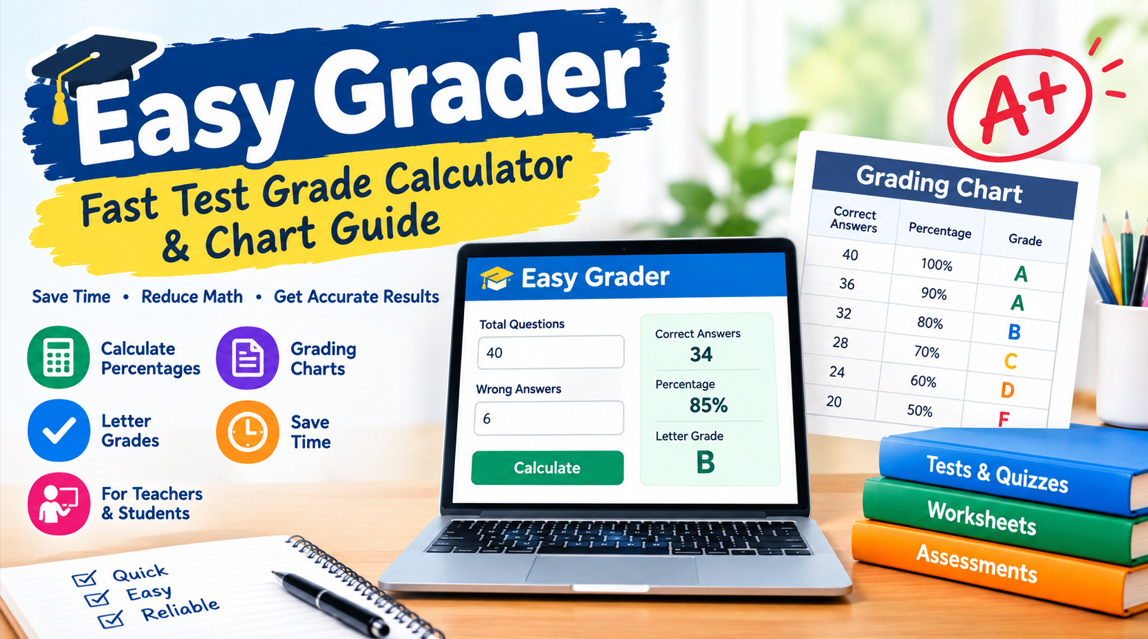
What Is an Easy Grader?
An Easy Grader, also called an EZ Grader or grade calculator, is a simple tool that helps teachers, tutors, students, and parents calculate test scores quickly. Instead of manually converting correct and incorrect answers into percentages, users can enter basic test information and determine the resulting score.
The main purpose of an easy grading calculator is to make routine assessment calculations faster and more consistent. It is especially useful for quizzes, objective tests, worksheets, classroom assignments, and exams where scores are based on the number of correct answers.
- Simple grading calculator
- Online EZ grader
- Test score calculator
- Percentage grade calculator
- Teacher grading tool
- Quiz grade calculator
- Automatic score checker
- Classroom grading helper
How Does an Easy Grader Work?
An Easy Grader generally works by comparing the number of correct answers with the total number of questions. If a student misses several questions, the calculator determines how many answers were correct and converts that result into a percentage. A compatible grading scale can then convert the percentage into a letter grade.
The basic process is straightforward and does not require advanced mathematics. For example, on a 20-question test, a student answering 18 correctly receives 90%. Depending on the grading scale being used, that percentage can then correspond to a particular letter grade.
- Enter total questions
- Enter incorrect answers
- Calculate correct answers
- Determine the percentage
- Apply the grading scale
- Display the letter grade
- Check the final score
- Review the grading chart
Easy Grader Formula Explained
The basic formula behind an Easy Grader is correct answers divided by total questions, multiplied by 100. To determine the number of correct answers, subtract incorrect answers from the total number of questions. This provides the raw score needed to calculate the percentage accurately.
For example, if an assessment contains 50 questions and a student gets 45 correct, the calculation is 45 ÷ 50 × 100 = 90%. The same process works for many different test sizes, making the formula useful for teachers and students who want to verify an automated result.
- Correct = Total − Wrong
- Percentage = Correct ÷ Total
- Multiply by 100
- Check total questions
- Count incorrect answers
- Verify correct answers
- Review calculated percentage
- Convert percentage to grade
Why Teachers Use an Easy Grader
Teachers often grade numerous quizzes, tests, and worksheets, so repetitive calculations can consume valuable time. An easy grader reduces this repetitive work by providing a quick way to determine percentages and letter grades. This can make the marking process more organized, especially when many papers use the same scoring method.
A grading calculator can also help maintain consistency. When the same formula and grading scale are applied to every paper, teachers can reduce simple arithmetic mistakes. Although it does not replace professional judgment when evaluating written work, it can simplify objective score calculations.
- Faster test grading
- Less repetitive math
- Consistent calculations
- Quick percentage results
- Easy score verification
- Useful for quizzes
- Helpful for worksheets
- Convenient classroom tool
Easy Grader for Students and Tutors
Students can use an Easy Grader to understand how their correct and incorrect answers translate into percentages. This makes it easier to check practice-test results or understand a score after completing an assessment. It can also help students become more familiar with percentages and common grading systems.
Tutors can benefit from the same approach when checking short assessments during lessons. Instead of repeatedly calculating percentages manually, a grading calculator can provide a quick reference. This allows more attention to remain on explaining concepts, reviewing mistakes, and supporting learning.
- Check practice scores
- Understand percentages
- Review test performance
- Verify calculations
- Estimate letter grades
- Support tutoring sessions
- Analyze quiz results
- Learn grading basics
Easy Grader Chart and Score Conversion
One useful feature of an EZ Grader is a grading chart. Rather than calculating every possible score separately, a chart can show how different numbers of incorrect answers correspond to correct answers, percentages, and letter grades. This can be particularly convenient when grading a large stack of similar assessments.
For instance, a teacher grading a 25-question quiz can quickly identify the percentage associated with each possible number of mistakes. A score chart can therefore function as a quick grading reference. However, the exact letter grade depends on the grading scale established by the school, teacher, or institution.
- Shows possible scores
- Lists correct answers
- Displays wrong answers
- Converts scores to percentages
- Supports quick reference
- Helps grade multiple papers
- Reduces repeated calculations
- Makes marking easier
Benefits of Using an Online Easy Grader
An online Easy Grader can simplify grading because calculations are performed automatically. Users do not need to repeatedly divide numbers or manually convert percentages into letter grades. A straightforward interface can make the process accessible even for beginners who are not comfortable with mathematical calculations.
Another advantage is convenience. A browser-based grading calculator can generally be used from a computer, tablet, or smartphone without requiring complicated software. For teachers, this can make quick score checking easier during preparation, marking sessions, or classroom activities.
- Automatic calculations
- Beginner-friendly interface
- Quick score results
- Convenient access
- Less manual arithmetic
- Useful on multiple devices
- Faster grading workflow
- Simple score checking
How to Use an Easy Grader Correctly
Start by confirming the total number of questions or points in the assessment. Next, determine the number of incorrect answers or the number of correct answers, depending on how the particular calculator is designed. Enter the information carefully and review the displayed percentage before recording the final grade.
It is also important to confirm the grading scale. Different schools and instructors can use different thresholds for letter grades, plus/minus grades, or pass/fail results. A percentage may therefore remain the same while its corresponding letter grade changes under another grading policy.
- Confirm total questions
- Count answers carefully
- Enter accurate numbers
- Check the calculated score
- Verify the percentage
- Confirm grading thresholds
- Review the final letter grade
- Record the result accurately
Easy Grader vs. Manual Grade Calculation
Manual grading requires users to count correct answers, subtract mistakes, calculate a percentage, and potentially convert that percentage into a letter grade. For a single short quiz, this may be simple. However, repeating the process across dozens of assessments can become tedious and increase the possibility of arithmetic errors.
An Easy Grader automates the calculation portion of this process. It is especially useful when the assessment uses straightforward right-or-wrong scoring. More complex assessments involving essays, weighted categories, partial credit, or different assignment weights may require a specialized grading system instead.
- Manual math takes longer
- Automated grading is faster
- Both use scoring information
- Easy graders reduce repetition
- Manual checks can verify results
- Weighted grades need different tools
- Essays require teacher evaluation
- Grading policies still matter