
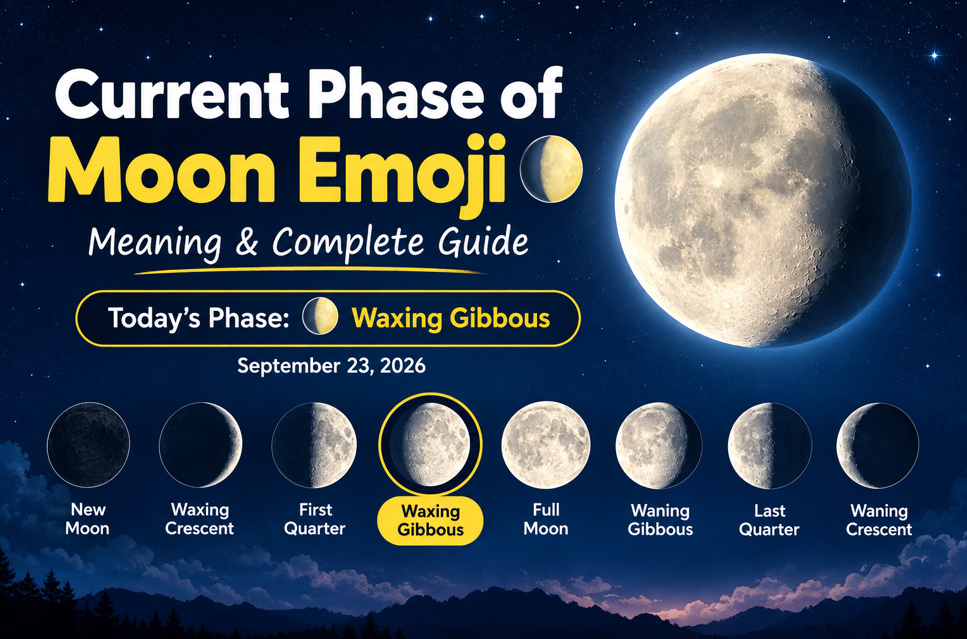
The current phase of moon emoji is a simple way to represent what the Moon looks like during its lunar cycle. As of September 23, 2026, the Moon is in a waxing gibbous phase, meaning more than half of its visible surface is illuminated and the illuminated portion is increasing. The Moon is approaching the September Full Moon.
The corresponding emoji is 🌔, commonly called the Waxing Gibbous Moon emoji. It can represent the actual lunar phase, nighttime, astronomy, beauty, mystery, dreams, or a growing feeling or idea. The Moon is approaching its Full Moon phase, making 🌔 an appropriate representation for the current lunar stage.
🌔 What Is the Current Phase of Moon Emoji?
The current phase of Moon emoji is 🌔 Waxing Gibbous Moon. The term “waxing” means the illuminated portion is increasing, while “gibbous” means more than half of the Moon appears illuminated. The Moon is therefore close to being full but has not yet reached the Full Moon phase.
Moon phase emojis provide a visual shorthand for the eight major lunar phases. They are useful when people want to communicate nighttime, sky watching, lunar beauty, astronomy, dreams, or a specific stage of the Moon without writing a lengthy explanation.
- 🌔 Waxing gibbous
- 🌕 Full moon
- 🌖 Waning gibbous
- 🌗 Last quarter
- 🌘 Waning crescent
- 🌑 New moon
- 🌒 Waxing crescent
- 🌓 First quarter
🌔 What Does the Waxing Gibbous Moon Emoji Mean?
The 🌔 emoji represents a Moon that is more than half illuminated and continuing to grow toward a Full Moon. Its astronomical meaning is connected with the waxing gibbous lunar phase. It is different from 🌕 because the visible Moon has not yet reached complete illumination.
In everyday communication, however, 🌔 can have broader meanings. Someone might use it to create a dreamy nighttime mood, discuss astronomy, decorate a caption, or symbolize growth and progress. The exact emotional meaning depends on the surrounding words and context.
- 🌔 Growing moon
- 🌔 Almost full
- 🌔 Nighttime
- 🌔 Astronomy
- 🌔 Moon watching
- 🌔 Mystery
- 🌔 Dreams
- 🌔 Natural beauty
🌙 How the Moon Phase Changes
The Moon does not produce its own visible light. Sunlight illuminates the lunar surface, and as the Moon orbits Earth, we see different portions of its sunlit side. This changing appearance creates the familiar lunar phases, including the New Moon, Crescent, Quarter, Gibbous, and Full Moon stages.
A complete cycle from one New Moon to the next takes approximately 29.5 days, known as a synodic month. During this cycle, the Moon gradually waxes from a thin crescent to Full Moon and then wanes back toward a New Moon.
- New Moon 🌑
- Waxing Crescent 🌒
- First Quarter 🌓
- Waxing Gibbous 🌔
- Full Moon 🌕
- Waning Gibbous 🌖
- Last Quarter 🌗
- Waning Crescent 🌘
🌕 When Will the Current Moon Become Full?
The waxing gibbous Moon on September 23, 2026, is approaching the September Full Moon. The Full Moon occurs on September 26, 2026. From September 23 onward, the illuminated portion continues increasing until the Moon reaches its full phase.
The exact illumination percentage and Moon-rise time can vary slightly depending on your location and the specific time of observation. However, the general lunar phase remains waxing gibbous during this period as the Moon moves toward fullness.
- September 23: 🌔 Waxing gibbous
- September 24: 🌔 Waxing gibbous
- September 25: Nearly full
- September 26: 🌕 Full Moon
- Illumination increases
- Moon brightness increases
- Lunar surface becomes easier to observe
- Full phase follows waxing gibbous
🔭 How to Observe the Current Moon Phase
A waxing gibbous Moon is particularly convenient for beginner skywatchers because it is bright and easy to recognize. You can observe it without specialized equipment, although binoculars or a small telescope can reveal additional lunar surface details such as craters, mountains, and the boundary between illuminated and dark areas.
The terminator, the dividing line between the illuminated and unilluminated portions, can be especially interesting through binoculars or a telescope. Shadows around this boundary can make lunar features appear more pronounced, providing an excellent opportunity for basic Moon observation.
- Look toward the evening sky
- Check local Moon-rise times
- Use your eyes first
- Try binoculars
- Use a small telescope
- Observe lunar craters
- Watch the terminator
- Compare the Moon nightly
📱 How to Use the Moon Phase Emoji in Text
The 🌔 emoji can make messages, captions, bios, comments, and posts more visually expressive. You can use it when talking about the actual Moon or simply when you want to create a peaceful, mysterious, romantic, or nighttime atmosphere.
Its meaning becomes clearer when combined with other emojis. For example, 🌔✨ can suggest a magical night, while 🌔🌌 can create an astronomy or night-sky theme. The emoji can also accompany captions about moonlight, stargazing, dreams, and peaceful evenings.
- 🌔 Good night
- 🌔 Moon watching
- 🌔 Starry night
- 🌔 Dreamy mood
- 🌔 Night photography
- 🌔 Sky watching
- 🌔 Moonlight
- 🌔 Peaceful evening
🌙 Moon Emoji Meanings Compared
Different Moon emojis represent different appearances in the lunar cycle. 🌑 represents a New Moon, 🌒 a Waxing Crescent, 🌓 the First Quarter, and 🌔 the Waxing Gibbous phase. 🌕 represents a Full Moon, while 🌖, 🌗, and 🌘 represent the corresponding waning stages.
Knowing these differences helps you select the appropriate emoji when discussing lunar astronomy. If your goal is specifically to represent the current Moon phase on September 23, 2026, 🌔 is the relevant phase emoji because the Moon is in its waxing gibbous stage.
- 🌑 New Moon
- 🌒 Waxing Crescent
- 🌓 First Quarter
- 🌔 Waxing Gibbous
- 🌕 Full Moon
- 🌖 Waning Gibbous
- 🌗 Last Quarter
- 🌘 Waning Crescent
✨ Why the Current Phase of Moon Emoji Is Useful
The current phase of moon emoji combines astronomical information with simple visual communication. Instead of explaining that the Moon is more than half illuminated and moving toward Full Moon, a single 🌔 symbol can communicate the basic idea instantly.
For websites, social media, educational content, messages, and astronomy discussions, moon phase emojis can make information easier to scan. They can also help readers connect a technical concept such as lunar illumination or the synodic cycle with a recognizable visual symbol.
- Easy visual explanation
- Useful for astronomy posts
- Great for captions
- Helpful in educational content
- Adds visual interest
- Represents lunar phases
- Supports nighttime themes
- Simple for beginners
🌕 Final Guide to the Current Phase of Moon Emoji
The current phase of Moon emoji is 🌔 Waxing Gibbous on September 23, 2026. The Moon is more than half illuminated and is continuing toward the September Full Moon on September 26. The exact percentage of illumination varies slightly according to location and observation time, but the lunar phase is waxing gibbous.
Understanding the Moon emoji is easier when you connect each symbol with the eight stages of the lunar cycle. Whether you are creating an astronomy article, writing a social media caption, sending a message, or simply checking the night sky, 🌔 is the appropriate emoji for today’s waxing gibbous phase.
- 🌔 Current phase
- 🌔 Waxing gibbous
- 🌕 Full Moon next
- 🌙 Lunar cycle
- ☀️ Sunlight creates phases
- 🌍 Earth observes the Moon
- 🔭 Great for skywatching
- ✨ Perfect for night themes